Inside Collab.Land: From Token Gating to Participation

by James Young, Founder, Abridged Inc., Makers of Collab.Land.
Collab.Land started with a simple idea: ownership should mean something online.
If you held a token or an NFT, you should be able to prove it. And communities should be able to act on that proof. That idea became token gating. Token gating became infrastructure. Quiet, boring, reliable infrastructure. That has always been our preference.
But infrastructure only matters if it evolves with the people using it.
Over the past few weeks, we surveyed 757 Collab.Land users to understand how the product fits into real usage and where it breaks down. The results were not surprising, but they were clarifying.
Collab.Land still works.
But it is no longer enough.
What Token Gating Solved and What It Didn’t
Token gating answered a binary question well:
Does the owner of a wallet have access to join?
That question powered an entire generation of crypto communities. It reduced spam. It aligned incentives. It allowed ownership to substitute for identity.
But communities do not stay binary for long.
People do not just want to get in.
They want to participate.
They want to contribute.
They want to understand where they stand.
Our survey made this clear:
- Nearly half of users still rely on Collab.Land primarily for wallet verification
- The biggest frustration is not bugs, it is confusion
- People want clarity around:
- what is required to get access
- why access changes
- what they can do next
- Over 50 percent said a Member Portal would be extremely valuable
- The most requested improvement was quests and rewards
This is the signal.
Access is table stakes.
Context is the missing layer.
The Real Problem Is Cognitive Load
Web3 does not fail because people do not care.
It fails because it asks too much, too fast, with too little explanation.
Too many wallets.
Too many rules.
Too many invisible states.
When someone loses access, they should not have to reverse-engineer a contract to understand why. When someone joins a community, they should not have to scroll for thirty minutes to figure out what matters.
Good systems reduce cognitive load without reducing freedom.
That principle shows up repeatedly in Vitalik’s writing: simple rules, legible outcomes, minimal trust assumptions. That is the lens we are using for what comes next.
SmartTag: From Gating to Guidance
The next phase of Collab.Land is SmartTag.
At a high level, SmartTag turns raw onchain signals like tokens, NFTs, and actions into clear participation states that both humans and communities can understand.
Instead of:
“You’re in” or “you’re out”
We move toward:
- Here is what you have unlocked
- Here is why
- Here is what is available to you now
This is not about adding layers.
It is about making the existing layers legible.
Exploring the Member Portal
Based directly on survey feedback, we are exploring a Member Portal built on top of SmartTag.
Not a dashboard for its own sake.
A place to orient yourself.
A Member Portal would help you:
- See which wallets you have connected and how they are used
- Understand your current access across communities
- View quests, actions, and rewards available to you
- Get explicit explanations when something changes
The goal is to centralize understanding.
Most users told us they are fine with reasonable constraints like wallet limits, flows, and steps, as long as the system explains itself.
Clarity beats flexibility when flexibility turns into chaos.
Participation Is the Point
The most important result from the survey was not about features.
It was about behavior.
People do not want passive access.
They want something to do.
Quests. Tasks. Contributions. Proof of participation.
That is where communities become real. Not when people show up, but when they act.
SmartTag lets communities define those actions cleanly.
The Member Portal gives members a place to see them.
Where This Is Going
Collab.Land is not moving away from token gating.
We are finishing the thought.
Ownership leads to context.
Context leads to action.
That progression keeps trust minimized, incentives aligned, and participation voluntary. It works with decentralization, not against it.
This is still early. We will move deliberately. We will share openly. And we will keep listening.
Thank you to everyone who took the survey. You did not just give feedback. You helped set direction.
Collab.Land is no longer just about getting access.
It is about knowing what to do once you are there.
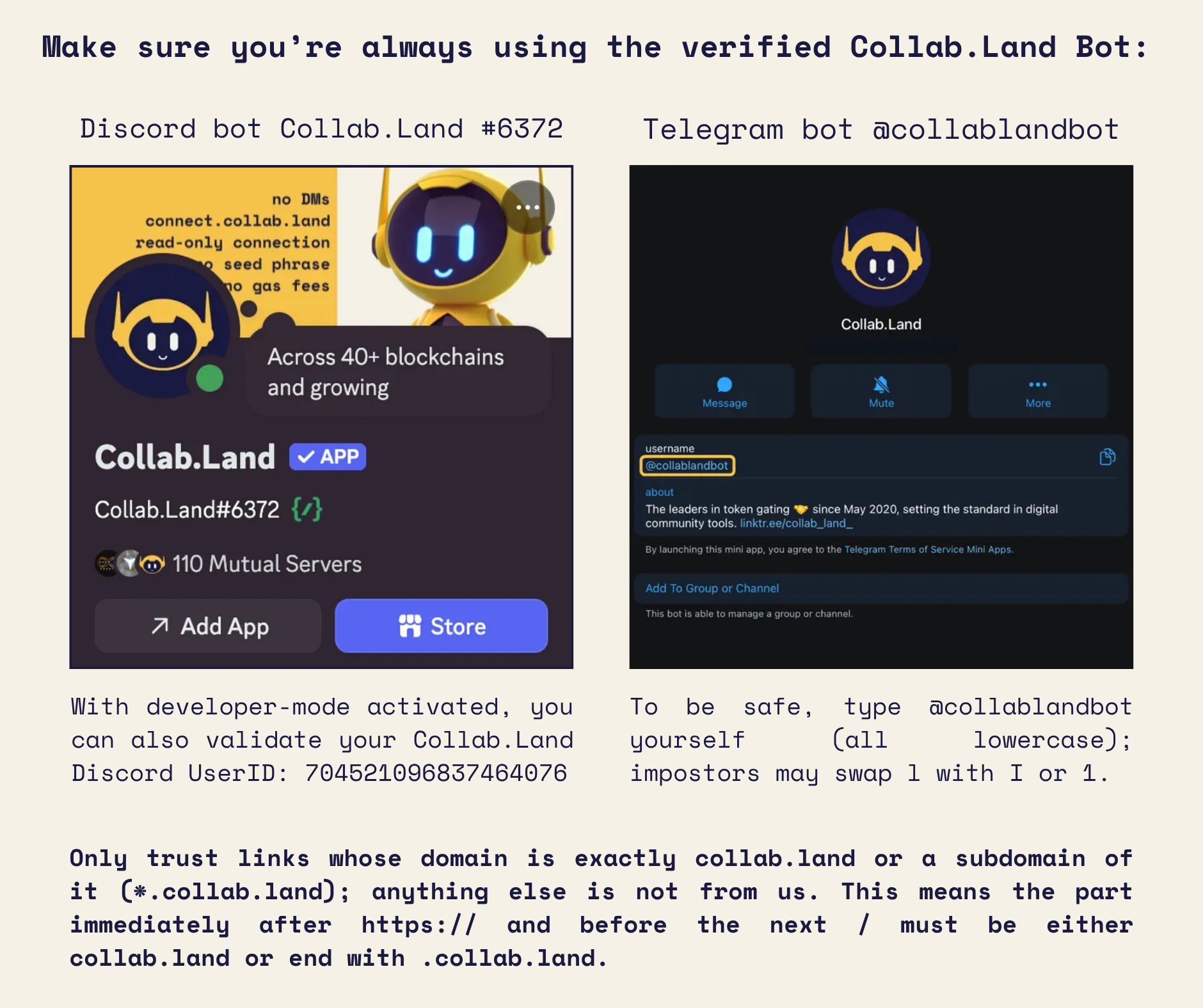
Collab.Land token gating and membership verification operates as a read-only application. By signing a message to add a new wallet, you affirm ownership of that particular wallet address. Collab.Land solely accesses public blockchains to verify that a member’s wallet addresses are linked to the required tokens for role or group membership. Collab.Land maintains no access beyond reading public wallet addresses, which are transparent to all users.