Inside Collab.Land: What 2025 Taught Me About Organizations
By James Young.
Last year, I wrote a post admitting that Collab.Land’s story was not smooth, clean, or particularly impressive if you were looking for a victory lap. It was honest because it had to be. We had been early, wrong, stubborn, lucky, and occasionally right, often in the wrong order. That post was mostly about survival. Staying in the game long enough to understand what game we were actually playing.
2025 was different.
Not because it was easier. It wasn’t. But because sometime in the middle of the year, something finally snapped into focus. Not a product idea. Not a feature. A structural realization.
Once you see it, you cannot unsee it.
For most of my career, I believed what most people building technology believe: code is the scarce thing. You hire engineers because code is hard to write. You plan roadmaps because code takes time. You argue about architecture because changing it later is painful.
That belief shaped everything. Agile. DevOps. Microservices. Endless abstractions designed to protect the sanctity of the codebase.
Then AI agents quietly made that belief obsolete.
Not dramatically. Not overnight. Just relentlessly.
By mid-2025, something uncomfortable became obvious. We were spending more time deciding what should exist than worrying about how to build it. Entire systems could be generated, discarded, and rebuilt in the time it used to take to debate a refactor. Rewriting was often cheaper than fixing.
That’s when it hit me.
Code is no longer the bottleneck.
Understanding is.
This does not mean code stopped mattering. It means code stopped being the asset.
The asset is behavior.
What the system does.
What it rewards.
What it prevents.
What it tolerates.
What it amplifies.
When code becomes cheap, behavior becomes expensive. And when behavior becomes expensive, organizations, not software, become the thing you are really designing.
This is the part most people miss. AI does not just change how software is written. It changes what an organization is.
At the same time this was sinking in, we were working closely with token gated communities. DAOs. Protocol ecosystems. Creator collectives. Mostly living inside Discord.
They were chaotic. Passionate. Occasionally dysfunctional. But they had something traditional startups spend years trying to manufacture: shared ownership, native distribution, strong identity, and real incentives.
What they lacked was not motivation. It was not capital. It was execution capacity.
They were organizations without an operating system.
Then AI agents arrived.
That was the second snap-into-place moment.
Tokenized communities plus AI agents do not give you better tools. They give you a new organizational primitive.
These were not communities pretending to be companies. They were companies pretending not to be.
Here is the inversion that matters.
Traditional organizations are built around people executing processes encoded in software. Programmable organizations are built around humans defining intent and constraints, while machines handle execution.
Humans decide what “good” looks like.
Machines make sure it happens.
When code is cheap, you stop optimizing for permanence. You stop worshipping reuse. You stop treating architecture diagrams like sacred texts. You regenerate systems around better understanding.
Agile does not disappear. It collapses into something simpler and more honest: express intent, observe reality, adjust.
Progress is no longer measured in pull requests. It is measured in behavioral change.
This has consequences most organizations are not ready for.
Departments stop owning systems. They own judgment.
Legal defines constraints. Finance defines incentives. Community defines norms. Engineering defines orchestration patterns.
AI agents are not senior engineers. They are tireless juniors who never complain, never forget, and never intuit what you meant. That last part matters.
Humans do not disappear. They become stewards of meaning, trust, and direction.
The organization itself starts to look more like a living system, continuously recompiled from intent.
This is why token gated communities matter so much.
They already have the raw ingredients of programmable organizations: capital, identity, reputation, governance, and incentives. What they have been missing is a way to execute at scale without centralizing.
With agents, that gap closes.
A Discord server stops being "just chat." It becomes an organizational runtime.
Channels become workspaces.
Roles become permission layers.
Tokens become incentive mechanisms.
Reputation becomes memory.
This is not theory. It is already happening.
In 2026, AI agents will not be a feature inside communities. They will be the operating layer.
Some will handle onboarding and access.
Some will surface signal and sentiment.
Some will enforce governance rules.
Some will issue incentives and verify work.
They will not create culture. They will execute it.
Culture still belongs to humans. Always will.
Which brings me to Collab.Land.
In 2026, we are going to dogfood this fully. Not in a marketing way. In a slightly uncomfortable way.
We are going to run Collab.Land itself as a programmable organization.
Agents inside our own Discord.
Constraints encoded instead of implied.
Coordination automated where it should be, surfaced to humans where it should not.
We will treat code as disposable.
Behavior as persistent.
Trust as the only thing that compounds.
Whatever actually works, whatever survives real usage, we will ship to the communities we serve.
Not as abstractions. As primitives.
Our goal is not to turn communities into companies they never wanted to be. It is to give internet-native organizations the execution capacity they have always needed, without losing what made them different in the first place.
Last year’s post was about resilience. About staying alive long enough to learn.
This year’s realization is simpler and heavier:
We are no longer building software for communities.
We are helping communities become programmable organizations.
2025 was the year code stopped being the hard part.
2026 is the year we find out what that really unlocks.
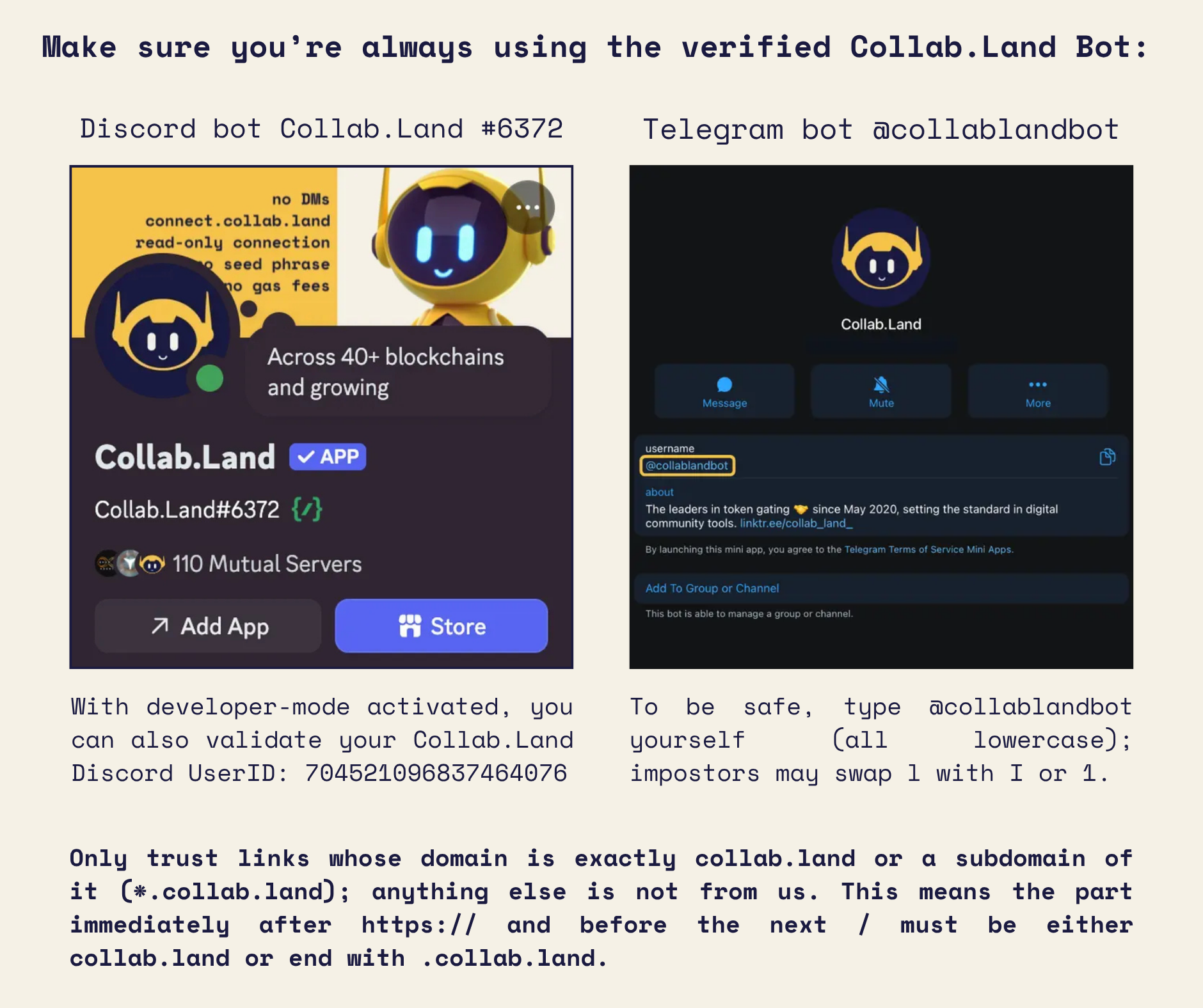
Collab.Land token gating and membership verification operates as a read-only application. By signing a message to add a new wallet, you affirm ownership of that particular wallet address. Collab.Land solely accesses public blockchains to verify that a member’s wallet addresses are linked to the required tokens for role or group membership. Collab.Land maintains no access beyond reading public wallet addresses, which are transparent to all users.